Voice AI
What an AI Voice Agent Does: Definition, How It Works, Use Cases 2026
By Mattia Carruggio · June 16, 2026 · 9 min
Technical and operational guide for US service businesses: what an AI voice agent is, how it works in 2026, and the concrete advantages for HVAC, auto shops, and home services.
AI adoption in US businesses has accelerated dramatically. According to McKinsey's 2025 State of AI report, 78% of organisations report using AI in at least one business function — up from 55% the year prior. Inbound phone communication is one of the highest-ROI areas to apply it.
The biggest pain for US small and mid-size businesses remains inbound call handling. Industry research shows that 20-30% of B2C calls to SMBs go unanswered or are handled with excessive hold times. An AI voice agent slots directly into that operational gap.
Definition: what an AI voice agent is in 2026
An AI voice agent is software capable of conducting two-way, real-time phone conversations using natural language. Unlike legacy systems, it doesn't replay pre-recorded prompts — it understands context and caller intent and responds dynamically.
In 2026, the evolution of Large Language Models (LLMs) has carried these systems past the "voice commands" era into a purely conversational mode. A voice agent doesn't just match keywords; it follows the thread of complex dialogue, handles interruptions, and adapts tone to the caller.
For a business owner, the voice agent acts as a digital co-worker that doesn't tire, runs 24/7, and can handle hundreds of simultaneous calls with the same precision. It's not a replacement for staff — it's an operational filter that frees human resources from repetitive, low-value tasks.
Difference between AI voice agent, traditional IVR, and text chatbot
Distinguishing the voice agent from earlier technologies matters when you're evaluating vendors. Buyers often conflate systems with completely different capabilities and goals.
Traditional IVR (Interactive Voice Response) is the classic "press 1 for…" tree. Rigid menu structure. If the caller has a need the menu didn't anticipate, the system fails. IVR frustration is one of the leading causes of call abandonment.
A text chatbot shares the AI logic but runs on a different channel. Voice imposes latency and phonetic-handling constraints that text doesn't. And the phone remains the preferred channel for urgent issues, mobile callers, and older demographics.
The 2026 AI voice agent surpasses both:
- No menus: caller speaks freely, like to a human.
- Sub-second latency: modern stacks respond in under 100 ms.
- Live integration: the agent reads from and writes to your CRM in real time during the call.
The four technical components: STT, NLU, LLM, TTS
To understand how an AI voice agent works, look at the engine. Each utterance flows through four sequential stages, all happening in fractions of a second.
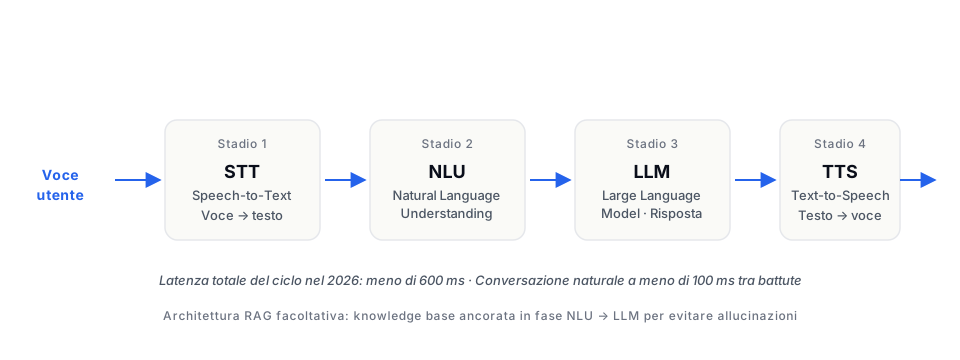
- Speech-to-Text (STT): the system's ear. Converts the audio waveform into written text. 2026 systems handle regional accents, background noise (traffic, wind, shop noise), and auto-correct phonetic mistypes.
- Natural Language Understanding (NLU): the comprehension layer. Extracts intent ("I want to book") and entities ("Tuesday at 3 PM"). Without solid NLU the system is just a transcriber.
- Large Language Model (LLM): the brain. Produces a logically correct response based on company instructions, conversation context, and data pulled from your database. This is where conversational fluidity comes from.
- Text-to-Speech (TTS): the mouth. Converts response text back into audio. Modern neural synthesis reproduces breathing, intonation, and natural pauses — no robotic metallic edge.
What it can do today: answer, qualify, book, route
Real-world applications for a US SMB touch every stage of the customer relationship. Configurability lets each shop point the agent at specific goals.
One of the most-requested functions is missed-call recovery. When the office is closed or all lines are busy, the agent steps in immediately. It doesn't just say "try again later" — it captures the reason for the call and starts the booking or support flow.
In commercial settings, the agent can:
- Qualify leads: asks budget, timing, vehicle/equipment info before passing the call to a salesperson.
- Book appointments: syncs with Google Calendar, Outlook, or shop-management software (Tekmetric, Housecall Pro, Jobber, ServiceTitan).
- Route calls: figures out whether the need is administrative or technical and warm-transfers to the right human without intermediate steps.
To evaluate interaction quality, listen to the demo audio — a real example handled in native English with natural conversation flow.
What it still can't do well (honest limits)
Despite 2026 technology, intellectual honesty matters. Voice AI isn't a universal solution for every human interaction.
First, complex commercial negotiations or high-emotion handling remain human work. A voice agent lacks the empathy to manage a customer furious about a botched repair or to run a multi-million-dollar contract negotiation where what's unsaid matters as much as what is.
High-level legal or medical advice is another hard limit. The AI can capture symptoms or case data but cannot — and should not — render diagnoses or definitive legal opinions in regulated contexts.
Severely degraded audio or multiple overlapping voices — a call from a noisy job site with two people talking at once — can still trip up the STT layer, leading to misunderstandings that require human handoff.
Three real US use cases: HVAC, auto repair, home services
Technology must answer vertical-specific problems. Three concrete US implementations.
HVAC and home services. During a summer heatwave or a February freeze, demand spikes outside business hours. The AI voice agent triages emergency vs. routine, pages your on-call tech for true emergencies (no heat, water leak, gas smell), and books non-urgent jobs for next business day — directly into ServiceTitan or Housecall Pro. See our dedicated AI receptionist for HVAC page.
Auto repair shops. Independent shops lose 18-30% of inbound calls to chains with centralised call centres. The agent captures year-make-model and symptom, quotes flat-rate jobs from your price book (oil change, tire rotation, brake pads), books diagnostics for ambiguous symptoms, and writes appointments into Tekmetric or Shopware. See AI receptionist for auto shops.
Professional services and intake. Law firms, dental offices, contractors of all kinds — anyone with a high cost-per-call. The agent identifies the caller via phone number, checks case status in the firm's database, gives status updates in real time, and only routes the calls that need a professional's judgement.
Compliance: TCPA, FCC AI-voice ruling, California SB 1001
Operating voice agents in the US requires careful attention to federal and state rules.
The FCC's Declaratory Ruling 24-17 (8 February 2024) classified AI-generated voice as "artificial voice" under the TCPA, which means certain disclosure and consent requirements apply. The conversational agent must identify itself as AI at the start of every call.
California SB 1001 (Cal. Bus. & Prof. Code § 17941) prohibits bots that mislead. The same disclosure obligation applies whenever a California resident is on the line.
On data protection, US states have begun enacting comprehensive privacy laws (CCPA/CPRA in California, VCDPA in Virginia, CPA in Colorado, and counting). Voice transcripts that include personally identifiable information fall under these regimes. Your provider should publish a TCPA Policy and treat call transcripts under the same security regime as other PII.
Typical costs and ROI in 30-90 days
The investment in an AI voice agent typically pays back in the first quarter. Unlike a human receptionist, there are no payroll taxes, benefits, sick days, or ongoing training overhead on routine processes.
Costs usually split into two:
- One-time setup: covers brain configuration, CRM/shop-management integration, and testing. Process takes 7 to 14 days.
- Subscription or usage: monthly fee tied to conversation minutes or call volume.
ROI calculates on three axes. First, direct labour savings on repetitive tasks. Second, the value of recovered leads that would otherwise be lost (the 20-30% missed-call rate). Third, efficiency gain: an agent that resolves 60-80% of calls autonomously (containment rate) lets your team bill more time on consultative, high-value work.
How to tell if it makes sense for your business
Not every business needs an AI voice agent. The decision should rest on data and call volume. If your operation takes fewer than 5 calls a day and always has someone competent ready to answer, automation may be premature.
Adoption is recommended if:
- You take calls outside business hours or on weekends.
- Staff burns more than 2 hours a day on data entry or FAQ-type answers.
- Your missed-call rate is above 10%.
- You handle seasonal peaks that saturate your lines.
Properly sizing the impact requires an internal-process audit. Often what looks like a staffing problem is actually a filtering problem.
Want to know if it makes sense for your business? Book 15 minutes with us — free, no commitment.
Frequently asked questions
- How long does it take to roll out an AI voice agent?
- A typical setup takes 7 to 14 business days from contract to live production, including integration with your CRM or shop-management software.
- How does it compare to hiring a human receptionist?
- Operating cost is substantially lower — cutting first-contact handling expense by roughly 60-80% compared to a dedicated full-time hire, with full 24/7 coverage.
- Does it actually sound natural? Any robotic accent?
- Current 2026 neural TTS produces fluent, native-quality American English with natural prosody. Most callers can't tell it's AI until the disclosure at conversation start.
- What happens when the agent can't answer?
- The agent is configured to escalate: warm-transfer to a human operator in real time, or capture a structured message and notify the team via CRM or SMS.
- Is this TCPA compliant?
- Yes. The agent identifies itself as AI at every call start per FCC Declaratory Ruling 24-17 (Feb 2024) and California SB 1001. Default inbound-only posture avoids most TCPA outbound concerns. See our TCPA Policy.